
Extended Context Test: what long inputs cost in time and memory
36 synthetic attempts across three local model configurations on an M4 Pro with 48 GB.
10 November 2026 · Daniel Tael
I extended my local model evaluation to answer a hardware question: what happens when the model has to read a genuinely long input? A short prompt with a large context setting does not answer that question. I wanted to separate the cost of reserving context from the cost of actually using it.
Read the original local LLM evaluation
This extension contains 36 synthetic attempts on one M4 Pro MacBook Pro with 48 GB of unified memory, 12 CPU cores, 16 GPU cores and macOS 27.0.1. All three configurations returned the correct facts and comparison in every attempt. Their waiting times and reported memory allocations differed substantially. This is a small context diagnostic, not a general model ranking.
Two questions, measured separately
Each model made twelve calls. Three allocation controls used the same short question with 16,384, 32,768 and 65,536 tokens of configured context. Nine long-input cases used approximately 8,000, 24,000 and 48,000 input tokens, placing the relevant records near the beginning, middle or end at each length. The context setting for those inputs was 16K, 32K or 64K respectively.
The synthetic records contained project budgets and plausible distractors. The model had to extract a budget, identify the higher-budget project, calculate the difference and return the two supporting record IDs as JSON. Ordinary code checked retrieval, comparison, evidence IDs and output format separately. The target facts stayed the same as distractors were added. Different tokenizers required different distractor counts, so inputs were equivalent in task and approximate token length, not byte-identical across every model.
The same correct content, different waiting times
Times are medians across three evidence positions, one attempt per position. Request time includes model loading and the post-response context-verification sample; it excludes the preceding model-unload operation. The correctness columns include all twelve calls, including the allocation controls.
| Model / configuration | ~8K input | ~24K input | ~48K input | Correct content | Content + strict format |
|---|---|---|---|---|---|
| GPT-OSS 20B (MXFP4) | 20 s | 54 s | 134 s | 12/12 | 12/12 |
| Nemotron 3 Nano 30B (MLX) | 27 s | 55 s | 104 s | 12/12 | 12/12 |
| Ministral 3 14B Reasoning (Q8) | 95 s | 244 s | 484 s | 12/12 | 0/12 |
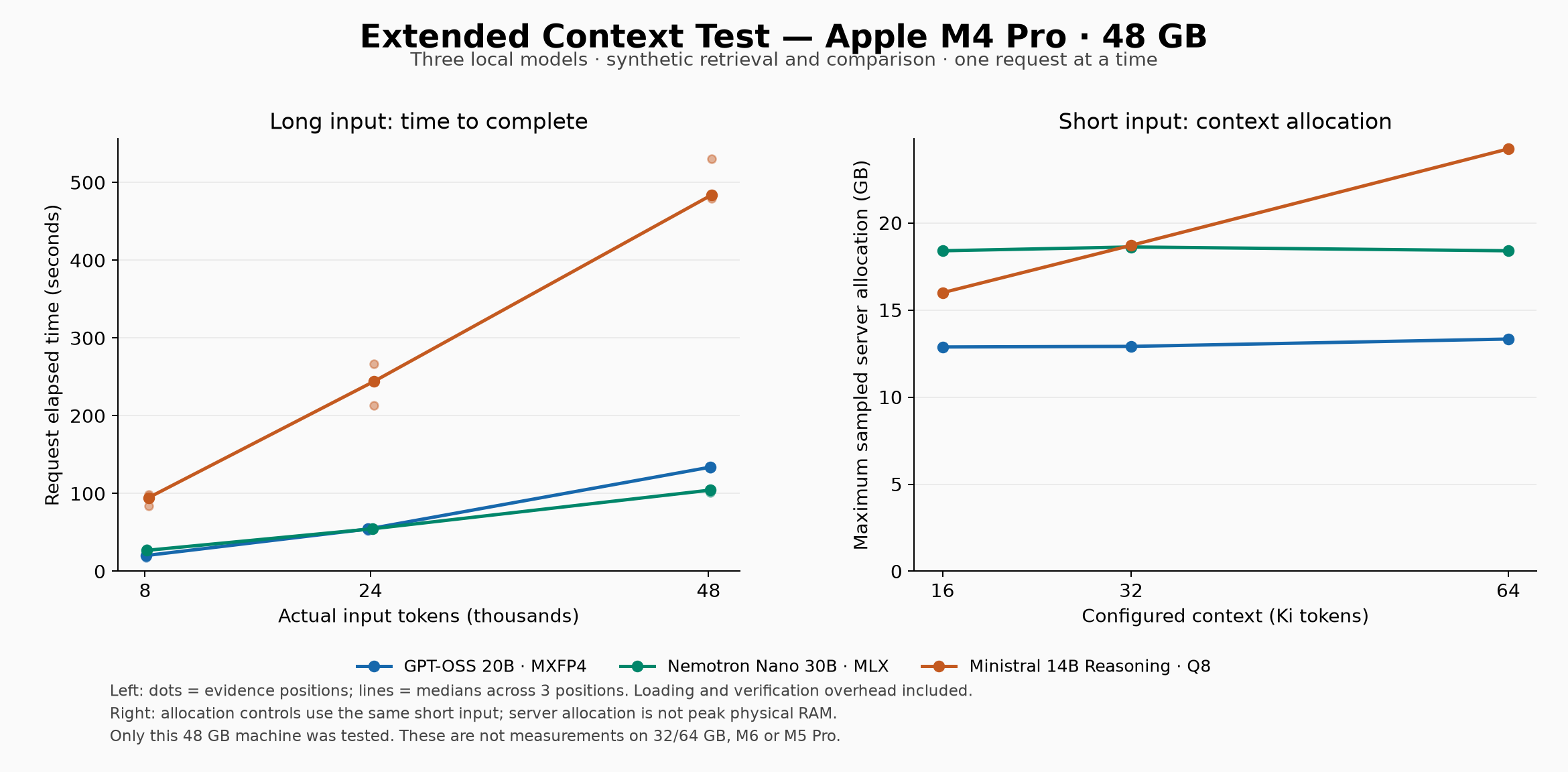
At roughly 48,000 input tokens, Nano finished in a median of 104 seconds, GPT-OSS in 134 seconds and Ministral in 484 seconds. All calls finished normally within the fixed ten-minute deadline. No request was retried, and none exhausted the output budget.
Ministral wrapped its JSON in Markdown code fences in every measured case, as it had in its separate two-case compatibility pilot. The contained JSON and facts were correct. That is why it scores 12/12 for content and 0/12 for the strict JSON-only contract. A deterministic parser could handle this particular presentation choice, but that does not change the recorded instruction-following result.
Reading the input dominated the longest requests
Fast output-token generation is only part of an agent job. Before producing an answer, the model needs to process the input. In Ministral’s first 48K case, the server reported about 413 seconds of prompt processing and 63 seconds of generation, out of 478 seconds of server time. The client-side request measurement was about 479 seconds. GPT-OSS also spent most of its longest requests on prompt processing.
That matters for my intended workflows. A scheduled overnight job may tolerate minutes of waiting. An interactive workflow, or an agent that repeatedly resubmits a long history, can make the same delay much more noticeable. This test measured independent requests, not a complete long-history Hermes workflow.
A larger context setting did not have the same memory cost everywhere
These controls isolate the context setting while keeping the question short. Values are decimal GB from the runtime inventory, not total machine usage or exact peaks. Small variations in reported allocation should not be read as intrinsic architecture differences.
| Model / configuration | 16K context | 32K context | 64K context |
|---|---|---|---|
| GPT-OSS 20B (MXFP4) | 12.88 GB | 12.91 GB | 13.33 GB |
| Nemotron 3 Nano 30B (MLX) | 18.40 GB | 18.62 GB | 18.40 GB |
| Ministral 3 14B Reasoning (Q8) | 15.99 GB | 18.71 GB | 24.25 GB |
Ministral Q8 increased from about 16.0 GB at 16K context to 24.3 GB at 64K, even with the short input. The other configured systems reported a much smaller change. Those observations compare model artifacts, settings and backends together; they do not establish an architecture-only effect.
The machine already had about 11.1 GiB of swap before testing, with idle swap counters unchanged. That historical usage is different from new paging during a request. Nano’s first measured loading produced about 752 MiB of new swapout traffic; none of its subsequent cases did. No new swapouts were observed during the GPT-OSS or Ministral cases. This was not a clean-boot experiment.
What this says about buying 24 GB or 32 GB
I did not test a 24 GB or 32 GB machine. I also did not test an M6 or M5 Pro. The measurements help estimate headroom, but model allocation alone cannot certify that another configuration will fit or perform equally well. macOS, the runtime, temporary loading allocations and GPU memory policies also need room.
GPT-OSS 20B looks like the strongest starting candidate when memory is constrained in this particular set of results. A 32 GB hybrid machine looks plausible for the bounded work I have in mind, with a cloud model for harder tasks. That is a purchase assessment from these measurements, not a verified hardware result. More RAM and faster input processing remain separate reasons to consider a more expensive machine.
Settings and limits
- One inference request at a time. Models were unloaded before each case, without flushing the operating system’s file caches.
- A 4,096-token output limit, including reasoning, and a fixed 600-second request deadline. No automatic retries.
- Requested seed 0. Temperature 0.7 for GPT-OSS and Nano; 1.0 for Ministral. GPT-OSS used medium reasoning, Nano used thinking=true, and Ministral used its native reasoning template. A requested seed is not a guarantee of determinism.
- GPT-OSS used MXFP4 GGUF, Ministral Q8_0 GGUF, and Nano an MLX artifact. Nano’s quantization label was not exposed by the runtime and remains unknown; its model digest is recorded. These are configured-system comparisons.
- Memory was sampled through the runtime and remote system counters. Sampled maxima are not exact peaks. The process-name RSS sampler can miss a generically named Python MLX worker; RSS and GPU allocations are neither complete nor safely additive.
- One attempt per task variant. The three evidence positions are not three reliability repetitions of the same prompt. Easy synthetic retrieval has ceiling effects and does not establish general long-document reasoning or autonomous-agent reliability.
- This extension does not replace the original screening scores or the deferred finalist repetition. All received raw outputs and failures from the earlier work remain preserved.
Evidence and next decisions
The saved responses were checked against frozen prompt hashes, model digests, settings, observed context sizes and input token counts. Scores and final-answer extraction were recomputed from the raw streams. This extension added 38 physical generations including the separate Ministral pilot. The wider reasoning and tool-evaluation evidence set now contains 356 case attempts and 460 physical model calls; earlier results are unchanged.
For my AI Enablement work, the useful question is which combination of local processing and cloud capability supports the jobs I actually run. These results give me a better basis for that decision: correctness, output contracts, context cost and waiting time can be evaluated separately. They do not establish that a local model replaces a frontier cloud subscription.
Download the reproducibility bundle: methods, configurations, raw responses and audit
Download the detailed measured report